
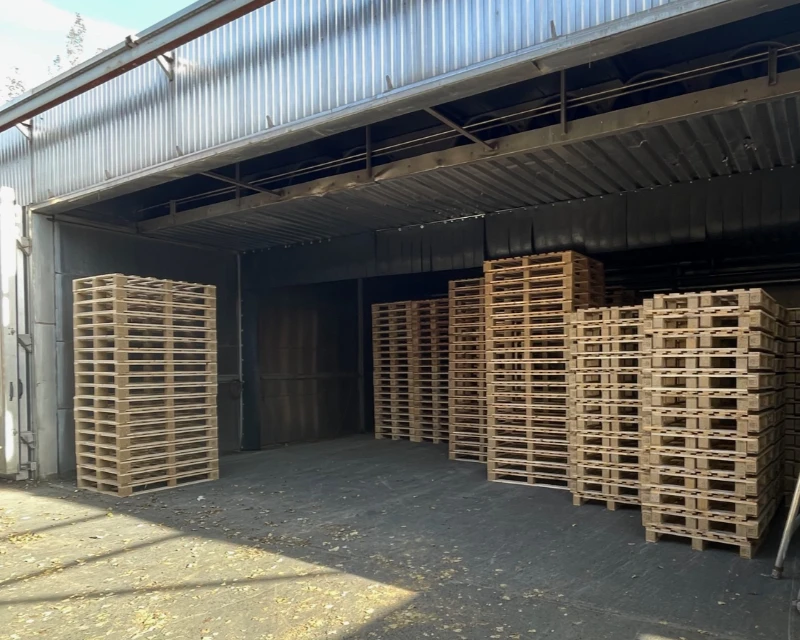
What are the benefits of heat treated wooden pallets?
If you’re in the market for heat treated wood pallets, it’s important to know what kind of pallets are best suited to your needs. Understanding the difference between heat treated and kiln dried wood helps to inform this decision.
What is the difference between kiln dried and heat treated wood pallets?
At Somerlap Pallets, there are two types of timber treatment we use to treat our wooden pallets.
Kiln drying involves heating wood in a kiln to reduce the moisture content of the timber. The timber remains in the kiln for at least 3 days, until the moisture content of the wood has been reduced to below 15%. This will also make the wooden pallets lighter and therefore cheaper to transport. As the pallet ages, the chance of the wood discolouring is also reduced.
We also heat treat our pallets, a process which involves heating our wood packaging in an onsite kiln for approximately 3 hours. We have to ensure the core temperature of the wood reaches a minimum of 56°C for at least 30 minutes.
What are the benefits of heat treated wood pallets?
Suitable for export
Heat treated wooden pallets meet the ISPM15 regulations, so they are suitable to be used for export. ISPM15 guidelines stipulate that all wooden forms of packaging have to be heat treated at a specific temperature and for a specific duration of time.
This industry standard for wooden pallets was established to prevent pests and diseases from being spread around the world. Heat treating kills any parasites and diseases that might be lurking in untreated timber – and ensures these pests won’t be introduced to other countries during shipping.
Heat treated pallets are stamped with an authentication mark that is internationally recognised to prove the timber is free from infestation.
How to read the HT stamp on a pallet
The HT stamp shows that a wooden pallet has been heat treated to the international ISPM 15 standard, so it can be used for export. It tells you where the pallet was treated, who treated it and which treatment was used.
What’s in the mark
The stamp is a bordered box with four elements:
- The IPPC symbol: the wheat-ear logo, on the left, which shows the pallet meets the international standard.
- A two-letter country code: the country where the pallet was treated. For UK-treated pallets this is GB.
- A producer number: a unique number issued by the national plant protection authority, so an inspector can trace the pallet back to the business that treated it.
- The treatment code: HT means heat treated. The other approved codes are DH (dielectric heating), MB (methyl bromide fumigation) and SF (sulphuryl fluoride).
Heat treatment is the most common method for UK and EU pallets.
Example layout: wheat-ear symbol | GB-FC177 HT

What the heat treatment involves
Somerlap heat treats pallets in its own on-site kiln. The core of the wood reaches at least 56°C for 30 minutes, which kills pests and disease in the timber. This is what allows the pallets to be used for export.
How to check a stamp is genuine
- A hyphen separates the country code and producer number (for example GB-0000).
- It’s legible, permanent and printed or branded, not handwritten and not smudged ink. Illegible or incorrect marks are a common reason for border rejections.
- It’s usually on two opposite sides of the pallet.
- The treatment code is HT, DH, MB or SF. Any other code is not recognised.
- The country code matches where the pallet was treated.
- Extra information such as “KD” (kiln dried) sits outside the border of the box. It isn’t part of the official mark and doesn’t prove ISPM 15 compliance.
Why it matters
Non-compliant pallets can be refused at the border, destroyed or sent back at your cost. Wood packaging moving between the UK and the EU, and into most other countries, needs a compliant mark.
Common questions
Is “kiln dried” the same as heat treated? No. Kiln drying lowers moisture, while heat treatment kills pests. A pallet can be both, but only the HT stamp proves ISPM 15 compliance.
Does a pallet need re-treating after export? No. Once it carries a valid mark it can be reused for international shipping, as long as the mark stays intact and the pallet isn’t repaired or altered. (Repaired or remanufactured pallets need to be re-marked by an authorised provider.)
How do I know a supplier is authorised? Ask for their producer number and a current certificate. Producers must be part of an approved UK marking scheme. Official guidance is at gov.uk/guidance/import-or-export-wood-packaging-material.
Increases durability and lifespan
Wooden pallets that have been heat treated are also far more durable than untreated pallets. They are safe to use in wet or humid environments, and less likely to sustain damage during transportation – protecting the integrity of whatever goods they are being used to ship.
The heat treatment process strengthens the timber of the pallet, making it far more resistant to rot. This increases the lifespan of heat treated wooden pallets, meaning it can be used for many years to come without replacement. Heat treated wooden pallets often last for up to ten years, and can then be recycled and used again.
Safer and cheaper to ship
Although kiln drying removes more moisture than heat treating, the moisture content of heat treated pallets is still significantly reduced. This makes the pallets lighter and therefore cheaper to transport.
Heat treated pallets are also less flammable than untreated pallets, reducing the risk of fire during transportation and wherever you store your pallets.
In need of heat treated wooden pallets?
If you require heat treated wooden pallets, Somerlap Pallets have got you covered. We also supply new pallets, reconditioned pallets, pallet crates, pallet collars, and many other forms of wooden packaging. Get in touch today, and we’ll help you fulfil any pallet requirements.
For all your wooden packaging needs, please contact us at Somerlap Pallets today.